Sylvanna Chapelle Employment Income Tax Computation with Travel Automobile Benefits Stock Options and Deduction Analysis
Accounting & FinanceTaxationWorked Solution
Sylvanna Chapelle, a national sales manager at Merche Tools Ltd. in Peterborough, Ontario, presented the following information for the current taxation year.
1) Gross salary…………………………………........$48,000
Bonus based on sales…………………………………….40,000
Less payroll deductions:
Employee contribution to a Registered Pension Plan……..(4,000)
Canada Pension Plan contributions……………………….(2,307)
Employment Insurance contributions……………………….(840)
Net salary $80,703
2)
Meals while travelling out of town (45 days) ........$ 1,500
Accommodation……………………………………..5,200
Airfare………………………………………….……7,800
Taxi……………………………………………………500
3) Client promotion costs:
🔒
Unlock the complete assignment
You are viewing the free preview. Purchase this assignment once to reveal the complete resource.
$9.99 USD
Secure checkout is completed by Stripe.
Company logo shirts and golf balls……………………….700
Client meals and entertainment…………………………2,200
Holiday gifts for prospective clients…………………….3,500
Annual golf membership………………………………..1,800
4) Sylvanna's employment contract also required her to travel to the Oshawa manufacturing plant and four other warehouse outlets in Southern Ontario. The corporation provided her with a new four-door van last year. The cost of the van, including HST of 13%, was $36,000. The company also paid $2,400 for 100% of the operating cost. Sylvanna used the vehicle for the full calendar year for both employment and weekend pleasure. Personal kilometres driven totalled 9,900 and total kilometres driven is 18,000.
5) Merche Tools also paid out the following amounts:
Tax return preparation for Sylvanna $ 350
Life insurance premium 150
REQUIRED
Compute Sylvanna's net income from employment for income tax purposes for the current year.
SOLUTION
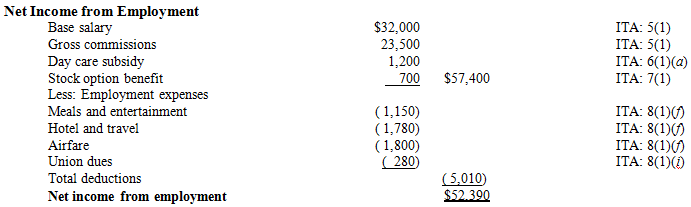
1. Stock option benefit = ($2.50 - $1.80) × 1,000 = $700. (The individual cannot elect to defer taxable benefit until the shares are sold since the stock option was exercised after March 4, 2010.)
2. Meals and entertainment: 50% × $ 2,300 (subsection 67.1(1)).
3. Stock option deduction = ½ × $700 benefit. This is not a deduction from employment income. Rather, it is a subsection 110(1) deduction from net income for tax purposes in the computation of taxable income.
4. EI and CPP qualify for a non-refundable tax credit against taxes payable.